Life on Mars? NASA says a rock sample shows potential signs of ancient life
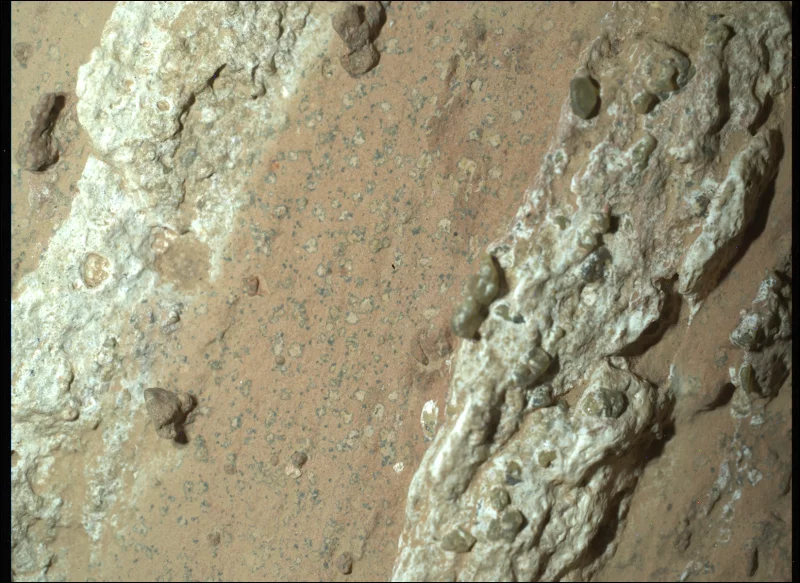
NASA's Perseverance Mars rover captured this image of a rocky area nicknamed "Cheyava Falls" on July 18, 2024, showing black "poppy seed" and larger "leopard spot" features. Researchers say a sample from the site reveals a tantalizing mix of details suggesting the potential presence of life, billions of years ago.
NASA scientists believe they may be closer than ever to answering the age-old question: Did life ever exist on Mars?
In a study published Wednesday in the journal Nature, researchers revealed that a Martian rock sample collected by the Perseverance rover shows promising signs of what could be ancient microbial life — known as potential biosignatures.
“This is the closest we’ve come to finding evidence of ancient life on Mars,” said Nicky Fox, associate administrator for NASA’s Science Mission Directorate, during a press conference in Washington. “And we’re very excited about it.”
The rock sample, named Sapphire Canyon, was collected in July 2024 from the edge of a dried-up riverbed called Neretva Vallis. The area once fed water into Jezero Crater, a site chosen for exploration because of its ancient terrain and history of water activity — ideal conditions for preserving traces of past life.
“These are some of the oldest rocks in the solar system,” said Katie Stack Morgan, Perseverance project scientist. “They offer a rare glimpse into a time when life was just emerging on Earth — and possibly on Mars as well.”
The rock features unusual patterns — including tiny black spots and larger “leopard spots” — that caught scientists’ attention. These types of textures are sometimes linked to biological processes.
“It’s similar to seeing fossil remains, or the chemical leftovers from microbial activity,” said Fox. “In this case, it might even be waste material from ancient microbes.”
Using instruments onboard Perseverance, scientists found that the rock contains minerals rich in iron, phosphorus, and sulfur — elements often associated with biological reactions on Earth.

Lead study author Joel Hurowitz of Stony Brook University explained that these minerals likely formed from interactions between mud and organic material. “On Earth, these features are usually byproducts of microbes consuming organic matter,” he said.
However, Hurowitz cautioned that non-biological processes, such as exposure to extreme heat, could also explain the findings. That’s why scientists are eager to analyze the sample more thoroughly — ideally, back on Earth.
NASA hopes to bring the sample home as part of its Mars Sample Return (MSR) mission. So far, Perseverance has collected 30 rock samples, with six collection tubes still available. But the return mission faces challenges: it’s costly, complex, and still under review.
While NASA has proposed landing the samples in Utah, budget cuts — including a proposal by President Trump to defund the MSR program — have delayed progress. In response, NASA officials are exploring new strategies to speed up and simplify the mission.
“We believe there’s a faster, more efficient way to bring these samples back,” said acting NASA Administrator Sean Duffy. “And it’s critical, because these missions help pave the way for our future plans — including returning to the Moon and eventually sending humans to Mars.”
About Post Author


