Indicted Democrat Judge Seeks Reelection as Texas Vote-Harvesting Case Expands

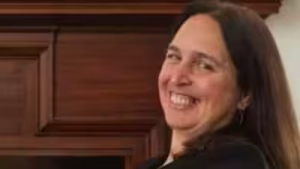
In Frio County, Texas, a suspended county judge facing multiple felony election-fraud charges has filed to run for reelection—while under indictment and barred from performing her duties without pay.
Rochelle Lozano Camacho submitted her candidacy paperwork on Dec. 5, just days before the state’s Dec. 8 primary filing deadline. Her next court appearance is set for March 12, 2026—nine days after the Texas primary.
Camacho was suspended in May 2025 by the State Commission on Judicial Conduct following her arrest in what prosecutors have described as one of the largest vote-harvesting investigations in recent Texas history. A Frio County grand jury has indicted her on three felony counts of vote harvesting, stemming from a two-year probe led by Attorney General Ken Paxton’s office.
Under the commission’s suspension order, Camacho cannot exercise judicial authority and receives no pay until her criminal case is resolved, dismissed, or reconsidered. Texas law, however, does not bar suspended officials from seeking reelection, a legal loophole Camacho has chosen to use.
Her case is part of a broader investigation that has already resulted in 15 indictments, many involving elected officials or political operatives across South Texas. Prosecutors allege Camacho and others engaged in a coordinated scheme targeting elderly and mail-in voters, collecting ballots illegally, and, in some cases, exchanging payments for votes or voter information.
The probe has expanded to include city council members, school board officials, county commissioners, and a former elections administrator accused of tampering with evidence. In June 2025, a second grand jury added nine more defendants, including former Bexar County Democratic Party chair Juan Manuel Medina and current Texas House candidate Cecilia Castellano.
Texas law treats compensated ballot harvesting as a felony, with penalties of up to 10 years in prison and $10,000 in fines. Prosecutors describe the violations as deliberate chain-of-custody breaches rather than administrative errors.
The timing of Camacho’s reelection bid raises concerns. Texas primaries are March 3, 2026, while her court proceedings begin March 12. Voters could be asked to cast ballots before a trial has taken place or evidence has been heard—a gap critics say is strategically significant.
Despite the scale of the investigation, national and state Democratic leaders have largely remained silent. Advocates for election integrity say the case underscores how vulnerabilities in election law allow indicted officials to remain in the political process.
Camacho’s candidacy has sparked debate about accountability and the safeguards necessary to protect voters. Critics argue that an indicted, suspended judge campaigning as if nothing occurred undermines public trust in elections.
Frio County’s upcoming election may serve as a test of whether Texas enforces election integrity as a principle or treats it as a formality.
About Post Author