How Romanian crime rings are draining US welfare accounts

A man prosecutors believe to be Ionut Ilie was placing a skimming device at a checkout in California, according to court records.© U.S. District Court for the Northern District of Ohio
–
On a chilly day in March, a twice-deported Romanian national walked into a 7-Eleven in Toledo, Ohio, and secretly affixed a device called a skimmer to a credit card machine, prosecutors say. The man was allegedly part of a California-based criminal crew led by a fellow Romanian nicknamed Piranha.
The gang’s aim, according to criminal charges, was to steal food-stamp benefits from customers who swiped their government-issued debit cards at the convenience store.
Court records show informants helped foil the plot. But authorities say the operation mirrors a playbook Romanian organized crime groups are using across the U.S. to swindle hundreds of millions of dollars in public benefits. Reliance by states on antiquated magnetic-stripe technology makes it easier.
The gangs depend on secretive “builders” who meticulously construct skimming devices that even diligent merchants can miss, investigators say. The illicit proceeds pay for rented luxury cars and homes with infinity pools, according to authorities. Cash in the form of crypto is spirited back to Romania and flows to real estate, gambling and crime bosses.
Since 2020, dozens of Romanian nationals have been prosecuted for welfare-card skimming in cities including McComb, Miss.; Laurel, Md.; and Portland, Ore. More than 50 people, many with Romanian ties, have been charged in Southern California, an early epicenter of the crimes and where many builders operate.
Despite the Trump administration’s crackdown on public-benefits fraud, criminals have broadened their tactics, authorities say. They use bots to guess welfare recipients’ account numbers. They also run bogus transactions with people’s food-stamp accounts through cloned credit-card machines, and then move the funds into their own bank account.
“Sadly, business is booming,” said Michael Peck, head of the Secret Service’s Global Investigative Operations Center, which combats financial crime.
‘A glorified hotel-room key’
The White House’s push has focused most visibly on Minnesota’s Somali community, with dozens of convictions dating to the Biden administration. But in recent years, Romanian gangs have been at the forefront of widespread benefits theft involving skimmers across the U.S.
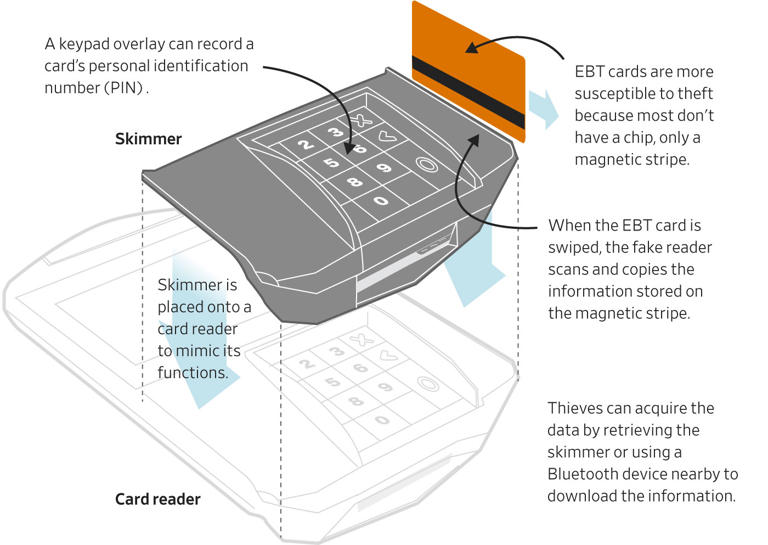
The criminals exploit a well-known flaw in the cards most low-income Americans use to obtain aid: magnetic-stripe technology invented in the 1960s.
Skimmers, which fit snugly over payment terminals and look nearly identical, electronically capture the account number and user PIN during a purchase. Often, criminals encode the data on blank cards, then withdraw cash from ATMs or buy items such as energy drinks to sell on the black market.
Most debit and credit cards today have microchips that boost antifraud security, and many allow tap-to-pay, the safest method. Few states have ponied up the millions to switch to the chip electronic benefit transfer, or EBT, cards that distribute welfare funds. Only Alabama, California, Maryland, Massachusetts, Michigan, New Jersey and Oklahoma have issued them, though others are in the process, the U.S. Department of Agriculture says.
“The insanity of letting people continue to use a glorified hotel-room key is akin to donating money to the Romanians,” said Haywood Talcove, chief executive of LexisNexis Risk Solutions’ government business, which works with public-sector clients to prevent fraud. Any type of payment card with a magnetic stripe is potentially at risk, authorities say, but EBT cards are the softest targets.
Victims feel the pain when thieves succeed. The federal government stopped replacing stolen Supplemental Nutrition Assistance Program benefits—long known as food stamps—in late 2024, and few states now pick up the tab. Defrauded SNAP recipients often must turn to family or food pantries until their next monthly allotment.
There are no recent official estimates of how much money has been stolen. But the Agriculture Department said the federal government replaced $360 million in benefits stolen from 754,000 households between October 2022 and December 2024, before Congress withdrew that authority.
“That was just from folks who actually called in,” said Agriculture Department Inspector General John Walk, adding that without reimbursements, “they’re probably underreporting even more than just a few years back.”
Global racket
Though not a monopoly, Romanian organized crime groups dominate the skimmer fraud racket, law-enforcement officials say. Gang leaders, typically based overseas, direct a loose hierarchy that relies on lower-level members for riskier tasks like installing skimmers. They frequently move from city to city under assumed names. Installation at a checkout counter takes seconds, often while a thief blocks a clerk’s view with an item such as a 12-pack of paper towels.
Many Romanians involved in the crimes are in the U.S. illegally, authorities say, having overstayed visas, failed to show for asylum hearings or sneaked over the border.
Last year, a Romanian national was arrested when he tried to re-enter the U.S. in a Mexican ambulance pretending to be an injured American, court records show. Agents suspected he had fake blood on his face. He was charged after federal agents determined the man, who had an economics degree, was part of a group of thieves who used fake cards to withdraw $105,000 in Los Angeles from New York EBT cardholders’ accounts.
The technological savvy used by the criminal groups dates back to the Cold War, when Romania’s Communist regime trained legions of engineers. As internet cafes proliferated, Romania also saw its rates of cybercrime skyrocket to one of the highest in the world, according to the State Department. By 2015, authorities say, Romanian crooks were carrying out pervasive ATM skimming in the Mexican tourist hubs Cancún and Cozumel.
The scammers intensified their focus on the U.S. during the pandemic as SNAP benefits ballooned. Average monthly spending on the program totaled $12 billion from April to September 2020, a 61% jump from a year earlier, according to the Agriculture Department.
California looked especially lucrative to the nascent gangs, authorities said, because residents get SNAP and cash welfare on one card. At one San Diego store in 2023, thieves used pilfered SNAP benefits to buy pallets of Red Bull to sell, according to a federal complaint.
California—one of the few states that reimburse victims—distributed millions of replacement chip-and-tap cards last year, using $76.5 million in federal and state funds for the upgrades. The monthly amount of stolen benefits the state has reimbursed residents plummeted from nearly $21 million in January 2024 to $4.3 million in July 2026.
Still, many California merchants aren’t yet equipped with chip-and-tap technology for their payment terminals. And authorities say thieves in some cases have been able to rig them so the chip-and-tap option is disabled, forcing people to swipe.
The state’s social-services department is pushing merchants to update their payment systems, yet swipe transactions still represent about 40% of all sales.
“EBT fraud will continue to be a vulnerability as long as benefit cards can be used with only the information stored on the magnetic stripe, without the added security provided by chip technology,” said Sabrina Feve, an assistant U.S. attorney in San Diego and a prolific prosecutor of the crimes.
Feve said the Romanian gangs’ decentralized nature makes them harder to dismantle. Skilled skimmer-builders are especially protected by the groups, she noted, rarely using stolen cards lest they get caught.
Skimmer hunting
Working with U.S. law enforcement agencies, Romanian officials are moving to seize assets in Romania acquired with skimming proceeds. “We are going against them,” said Maria Rîmniceanu, a prosecutor with Romania’s Directorate for Investigating Organized Crime and Terrorism.
In one case, officials seized a 2,500-square-foot home in Transylvania from a man accused by Romanian authorities of running a U.S. skimming operation from Europe and who was convicted under Romanian money-laundering laws.
Some fraud experts say the U.S. should scrap EBT cards and move to mobile wallet payments, given growing bot-driven crime and other means of stealing chip-card data. “Chip cards are not going to solve the problem,” said Mark Haskins, who probed SNAP fraud as branch chief for special investigations at the Agriculture Department until last year.
Skimmers are becoming more sophisticated. Many have Bluetooth transmitters that let gangs fetch stolen data by smartphone, rather than having to retrieve the devices.
Devices can sit undetected on a payment terminal for a year, said Vincent Porter, a Secret Service financial analyst, noting a single skimmer can compromise thousands of cards.
The Secret Service now regularly hunts for skimmers across U.S. cities while educating merchants to spot them. So far, 70 sweeps have yielded 694 skimmers, the agency said, preventing an estimated $720 million in fraud.
‘Special place in hell’
Prosecutors allege the California-based crew that hit Toledo had arrived in Ohio in late February. One man, Ionut Ilie, secretly took pictures of payment terminals at several Ohio stores and sent them to California, where Valentin Velicu ran a skimmer workshop from his home, an affidavit alleges.
A third alleged member of the group, Dragos Vasile, soon after went to a California post office, prosecutors say, to mail customized skimmers and fake IDs to Ilie, operating under the name Morgan Anderson.
Prosecutors claim Ilie installed skimmers in several Toledo and Cleveland-area stores in early March. With the help of informants, Ilie, Velicu, Vasile and a fourth Romanian man were apprehended. The group’s alleged leader, Constantin Ion, aka Piranha, was charged but not arrested. He couldn’t be reached for comment.
The four men in custody pleaded not guilty and are set for trial in January. Ilie’s lawyer told The Wall Street Journal he maintains his innocence; lawyers for the other three declined to comment or didn’t respond to inquiries.
To hobble criminals, Ohio officials in May added more card-locking features for SNAP recipients to protect their funds. Ohio’s legislature also passed a new law mandating chip cards for benefits.
“The problem is large enough that it’s having a significant negative impact on our most vulnerable citizens,” said Matt Damschroder, who directs Ohio’s SNAP program.
The chip transition will cost at least $20 million, he said, largely borne by the state. Full rollout of the new cards could take three years.
“There’s a special place in hell for people who steal from the poor,” said Democratic Ohio state Rep. Tristan Rader, a sponsor of the chip-card legislation. “And that’s what’s happening here.”
–
Original Article: How Romanian crime rings are draining US welfare accounts
About Post Author


