‘Torpedo Hit’: A $4.5 Billion U.S. Navy Aircraft Carrier Was ‘Sunk’ by An Old Dutch Diesel Submarine in 1999

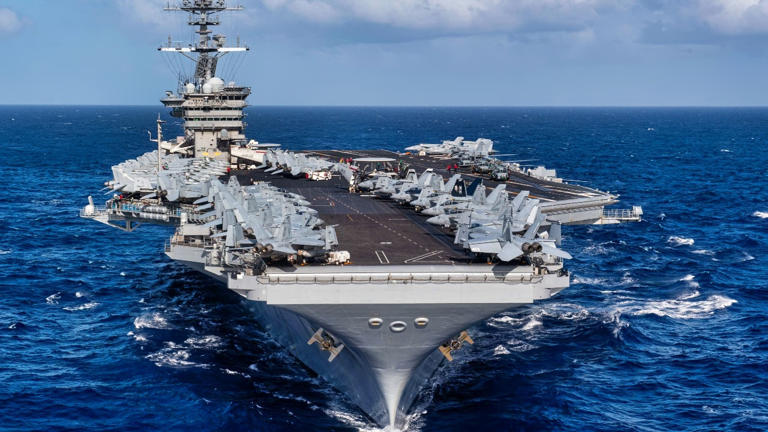
Souda Bay, Crete, Greece (Feb. 22, 2006) Nimitz-class aircraft carrier USS Theodore Roosevelt (CVN 71) heads to sea following a brief logistics stop on the Greek island of Crete. Roosevelt and Carrier Air Wing Eight (CVW-8) are currently underway on a regularly scheduled deployment supporting maritime security operations. Roosevelt is the fourth ship in the NIMITZ – class of nuclear powered aircraft carriers and is homported in Norfolk, VA. U.S. Navy photo by Mr. Paul Farley
–
–
During NATO Exercise JTFEX/TMDI 99 in 1999, the Dutch diesel-electric submarine HNLMS Walrus (S802) penetrated the layered defensive escort screen around the U.S. Navy’s Nimitz-class aircraft carrier USS Theodore Roosevelt (CVN-71) and notionally sank her in simulated torpedo attacks. The Walrus displaces only about 2,800 tons submerged, measures 222 feet, carries roughly 50 to 55 crew, runs on near-silent battery power, and is armed with four 533mm torpedo tubes and Harpoon missiles. The USS Theodore Roosevelt cost more than $4.5 billion to build, displaces 104,000 tons, carries 5,500 crew, and operates roughly 90 aircraft.
The Dutch diesel-electric submarine, as has occurred in so many training exercises in which US carriers battle diesel-electric submarines, successfully sank the American carrier in simulated torpedo attacks.
Why Do Cheap Diesel-Electric Subs Keep Sinking Expensive Carriers?
Why does this keep happening? How is it that carriers cost the US taxpayer billions of dollars to build and hundreds of millions of dollars to maintain, yet old, cheap diesel-electric submarines keep successfully downing those carriers in exercises?
It has to do with the underlying technology. While American carriers are modern marvels of nuclear engineering, able to serve as floating airbases, they are not impervious to the stealthy attacks submarines can conduct against them.
The Silent Killer: Why Diesel-Electric Subs are So Dangerous
That’s especially in the case of diesel-electric submarines.
You see, diesel-electric submarines, one of the oldest forms of submarine technology in the world, run on batteries that are quieter than those of nuclear subs. Because they lack nuclear reactors, they produce less noise than nuclear submarines when underway and are therefore harder to detect.
Plus, the manner of undersea warfare that most navies practice–notably navies employing older, less sophisticated diesel-electric submarines–relies heavily on stealth (silence) to conduct ambush attacks on the lumbering American carriers.
The true strength of diesel-electric subs is in their ability to conduct littoral warfare.
They are chokepoint champions. Diesel-electric submarines can position themselves in critical waterways, like the Strait of Hormuz or the Baltic Sea, quietly hang around waiting for American carriers and their escorts to float in, and create a kill box.
When the Defensive Screen Fails, Carriers Die
Even a Nimitz-class aircraft carrier, like the USS Theodore Roosevelt, is vulnerable to these diesel-electric submarines, especially under the right conditions.
And before anyone starts to raise a stink about how unfair the conditions of wargames can be for participating US forces, understand that warfare is unfair.
The kind of conflicts that America’s carriers fight tend to favor the conditions that these repeated examples of diesel-electric submarines exploit.
Any US carrier relies upon a layered defense that includes destroyers, cruisers, and anti-submarine warfare (ASW) helicopters. Even that screen can fail, leaving the carrier exposed.
Without that screen, the carrier lacks real defenses to prevent a silent killer, like a diesel-electric submarine, from getting a bead on the carrier’s vulnerable hull with their torpedoes.
For years, the Walrus-class diesel-electric submarines were in high demand among European NATO members for these exercises against US carriers because of their stealth.
What’s more, multiple NATO exercises over the course of decades in which European navies deployed various classes of diesel-electric boats were sent to sink US carriers repeatedly demonstrated that US carriers were vulnerable to these stealthy attackers.
USS Theodore Roosevelt: A Floating Super Target
The USS Theodore Roosevelt belongs to America’s legendary Nimitz-class aircraft carriers.
She displaces about 104,000 tons and can reach more than 30 knots underway.
Two nuclear reactors and four shafts propel the great ship. The carrier’s primary capability is the projection of naval airpower. Its air wing consists of roughly 90 aircraft, both fixed-wing and rotor-wing aircraft. The Teddy Roosevelt carries a crew of approximately 5,500 (ship personnel and air wing maintenance personnel).
As for defenses outside the battle group that forms the protective screen around the carrier, a US carrier carries RAM missiles, Sea Sparrow/ESSM missiles, and a Phalanx close-in weapon system (CIWS). A carrier is a big, tempting target, even to an older technology, like a diesel-electric submarine.
![Coming Soon] Attack of the Deep-Sea “Walruses”! - War Thunder Mobile - Online Military Action Game - Play for Free](https://static.wtmobile.com/upload/fileman/images/2025/09_september_25/db2_s24_ship_walrus/s24_db1_sub_stat_en_1525da9b2db90e69353116f78485e806.jpg)
HNLMS Walrus: Small, Cheap, and Deadly
As mentioned above, the HNLMS Walrus is a diesel-electric submarine.
It displaces around 2,450 tons when surfaced and around 2,800-3,090 tons when submerged.
Its length is around 222 feet, while its speed is between 20 and 21 knots when submerged. The submarine has a range of around 10,000 nautical miles and carries a crew of around 50-55.
Walrus’ primary armament is four 533mm torpedo tubes that can deploy around 20 torpedoes or mines.
The submarine can fire Harpoon missiles, too. What makes this submarine so deadly is its ultra-quiet battery operation.
Because the Dutch are NATO members, they have access to advanced sonar systems developed by the U.S. Navy.
These submarines are carrier hunters and conduct lethal ambushes, which is precisely what the Dutch subjected the Theodore Roosevelt to in 1999.
There’s also the grotesque cost asymmetry.
A carrier costs more than $4.5 billion at the time of the drill, while a submarine, especially a diesel-electric submersible, is a mere fraction of that cost.
Yet, a single diesel-electric submarine, like the HNLMS Walrus, can do disproportionate levels of damage to an American carrier.
As demonstrated in 1999, one of these older systems can easily penetrate the layered defenses of an American carrier, conduct catastrophic kills, and even escape undetected.
The Warning the US Navy Still Hasn’t Fully Answered
The Roosevelt’s experience in the 1999 NATO exercises against the Dutch diesel-electric submarine is another reminder that American carriers are extremely vulnerable.
In the wrong environment, against the right adversary, even the most powerful warship ever created–an American aircraft carrier–can be hunted and killed by something far smaller, less advanced, quieter, and cheaper.
Despite this having been demonstrated repeatedly over decades, it does not seem that the United States Navy has fully adapted its defensive posture to this painful reality.
Given the expeditionary nature of the US force, these floating targets will go deep inside enemy territory–near or inside key chokepoints where the silent killers that are diesel-electric subs are prowling in wait–at some point, an American carrier will either be critically damaged or sunk.
Once the United States loses one of its pricey carriers, a symbol of American military dominance, it will lose critical power-projection capabilities that it will be hard-pressed to replace during a high-intensity fight with a peer adversary.
Should such a war erupt (which it might very well do soon), the changes to the US Navy’s doctrine and force posture to mitigate the potential loss of one (or more) carriers in combat would take far longer to implement than the timeline for a possible great-power war allows.
–
About Post Author