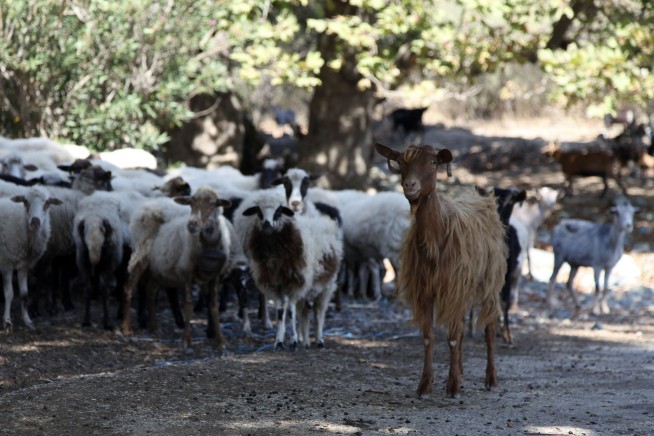
A shepherd moves his sheep from a road in the village of Karousades, on the Ionian island of Corfu, northwestern Greece, in this 2013 file photo. (AP Photo/Thanassis Stavrakis, File)
A major outbreak of sheep and goat pox is threatening Greece’s famed feta cheese industry, prompting the nationwide culling of hundreds of thousands of animals and sparking fears of supply shortages for what many Greeks call their “white gold.”
The disease was first detected in northern Greece in August 2024 and has since spread rapidly. According to the Ministry of Rural Development and Food, more than 1,700 outbreaks have been recorded, resulting in the culling of over 400,000 sheep and goats—roughly 5% of the country’s entire stock.
The crisis is hitting dairy farmers particularly hard. Sheep’s milk used for feta production is a cornerstone of Greece’s agricultural economy, generating nearly $1 billion in exports last year, the BBC reports. But many farmers say government compensation—typically between $144 and $240 per animal—doesn’t come close to covering their financial losses. Some have also criticized the state’s handling of the crisis, noting that a national committee to manage the outbreak wasn’t created until late October, more than a year after the virus first appeared.
In this Sept. 7, 2019, photo, goats and sheep graze freely near the beach in Kipos village, on Samothraki island, northeastern Greece. (AP Photo/Iliana Mier)
Veterinarians and producers have complained of understaffing, lagging containment measures, and delayed regional lockdowns. Government officials maintain they have followed European guidelines and argue that failures to follow biosecurity rules contributed to the spread.
Small dairies are already finding it difficult to obtain enough sheep’s milk, and industry experts warn that feta shortages and price increases could follow if the outbreak continues. Under EU protected-origin rules, authentic feta must be made in Greece with at least 70% sheep’s milk, meaning foreign substitutes cannot fill the gap.
Growing calls for mass vaccination have sparked debate, with officials concerned that inoculating entire herds could lead to Greece being labeled endemic for the disease, potentially harming export markets. Farmers—many still recovering from the devastation caused by storm Daniel in 2023—say they need more support and faster relief.
“In Thessaly, we thought we were finally getting back on our feet,” sheep breeder Vagelis Karajiolis told Reuters in September. “Then the sheep pox came and finished us off.”