Could Your Water Filter Be A Counterfeit?

When it’s time to replace your refrigerator’s water filter, it’s important to buy a replacement filter that is designed to work specifically with your fridge. But did you know off-brand and generic filters aren’t the only potential risk in buying a new water filter? The risks that face your water quality and safety go beyond what’s in your city’s water supply. Counterfeit water filters have made their way into online marketplaces all over the world, and sometimes it’s hard to tell the difference at first glance. But counterfeits are not the same as the real thing. Read this helpful guide so you can ensure you’re getting a genuine filter for your fridge.
What are the dangers of counterfeit filters?
They look the same as Genuine filters, and may even produce water that looks the same, but counterfeit water filters are not the same. In fact, they usually do more harm than good to your water. Contaminants like lead and chlorine require specialized technology like the three-step carbon filtration that genuine filters use, to filter them out. Counterfeit filters don’t contain enough – if any – of the filtering materials necessary to keep them out of your water.
Beyond the risk to your water, counterfeit filters can do serious damage to your appliance. Your refrigerator is a complex system of parts designed to work together, so when you add a counterfeit part that doesn’t fit, it can cause water to leak into your home, or worse. When a counterfeit filter claims to be the real thing, many families are unknowingly exposing themselves to water that’s not been filtered to quality standards.
HOW TO SPOT A FAKE:
Better-made fakes can be nearly impossible to spot from the exterior, even for experts. But there are a few things to watch out for if you suspect a filter may not be the real thing.
WEIGHT
Counterfeit water filters often weigh less than genuine water filters because they don’t contain as much of the important filtering materials inside – like activated carbon used in genuine filters. Some counterfeits have been found to have nothing but newspaper inside!
CERTIFICATION SYMBOL
Genuine water filters are NSF Certified and have the symbol stamped on the package. Counterfeits may have a fake, incorrect symbol, or may not have a certification mark at all.
PACKAGING
Counterfeits are designed to look nearly identical to the real thing, often coming in glossy or nicer looking packaging designed to trick you into trusting what’s inside.
COST
Most people that end up with counterfeit water filters bought them because they cost less than a genuine filter. Genuine filters are tested and designed to meet NSF and manufacturer standards, so if you find something significantly cheaper than the brand-name alternative, there’s probably a reason.
ONLINE CONTENT
If you’re buying online, be on the lookout for up-to-date packaging, enriched product information, and performance data sheets. If the page doesn’t have any of those, you’re probably looking at a counterfeit.
IMAGES & TEXT
Look closely at any images. Counterfeits tend to have grainy or pixelated pictures. Also, check for discolored or faded text, as that might be another sign you’re not looking at the real thing.
THE BOTTOM LINE
Counterfeits aren’t just a problem manufacturers use to scare you into buying their products. The risks are real – from failing to properly filter your family’s water to potentially damaging your appliance and your investment. Buy direct from authorized sellers to be sure you’re getting the real thing.
Nearly 4,000 Fraudulent Refrigerator Water Filters Seized by CBP at LA/LB Seaport
LOS ANGELES— U.S. Customs and Border Protection (CBP) officers assigned to the Los Angeles/Long Beach Seaport, in coordination with Import Specialists assigned to the Machinery Center of Excellence and Expertise (Machinery Center), seized 3,940 water filters bearing counterfeit National Sanitation Foundation (NSF) logos printed on the products. If genuine, the seized filters would have had an estimated manufacturer’s suggested retail price (MSRP) of $149,681.
CBP officers discovered the filters while conducting an examination of a mixed ocean freight arriving from China. The items were seized on April 10, after Machinery Center Import Specialists confirmed that the filters bore unauthorized NSF certification marks that had been recorded for border enforcement through CBP’s e-Recordation program.
“Consumers buying water filters on e-commerce sites should be aware that is extremely difficult to spot those containing fraudulent copied certifications,” said Carlos C. Martel, CBP Director of Field Operations in Los Angeles. “We are advising consumers to protect their families by ensuring they are purchasing these products from legitimate sources only.”
NSF International is an accredited, third-party certification body, which tests and evaluates products to public health and safety standards. Products certified by NSF must be tested, evaluated and determined to comply with specific standards, policies and procedures before they are authorized to bear the NSF certification mark..
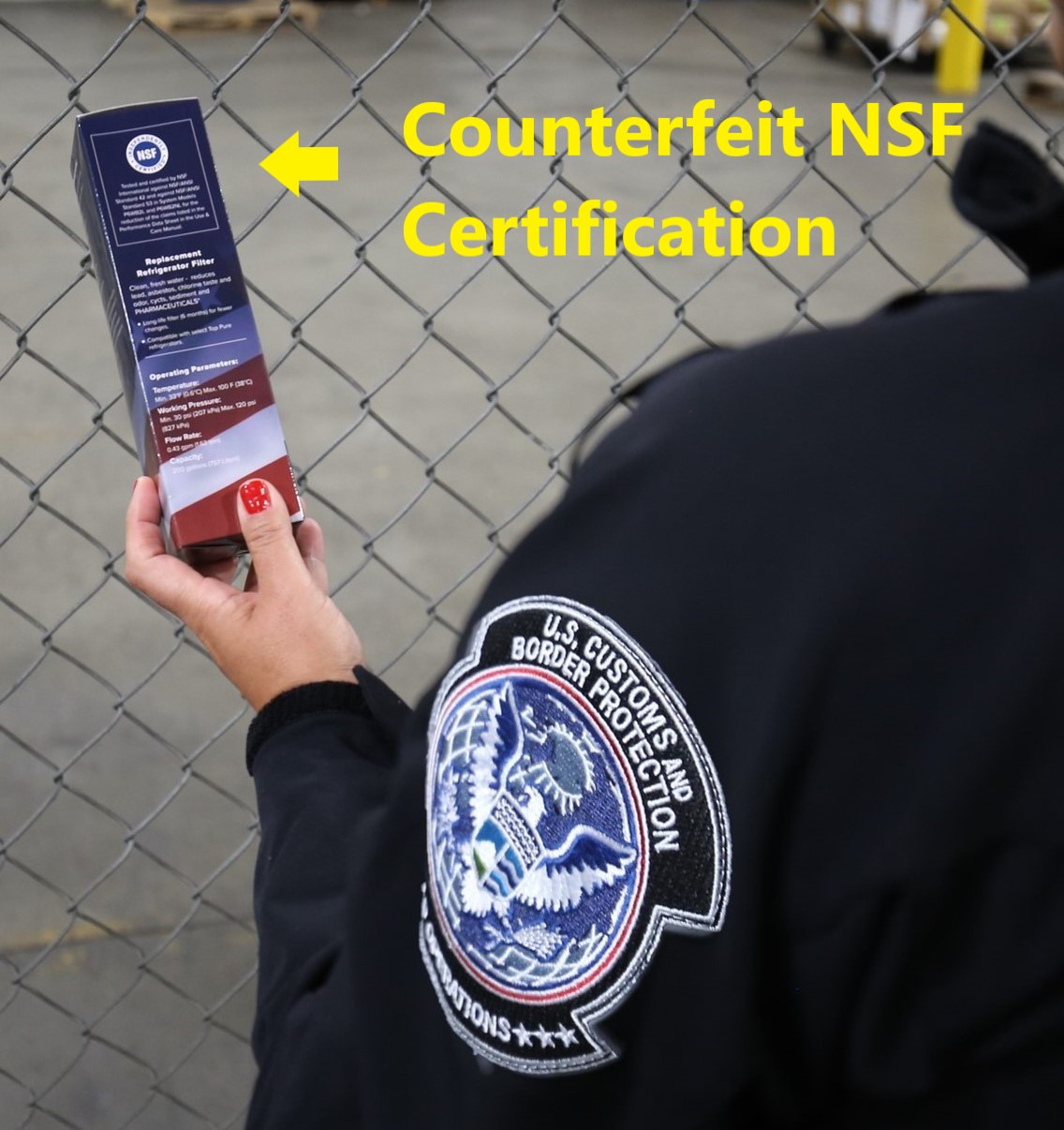
According to the Association of Home Appliance Manufacturers (AHAM), counterfeit refrigerator water filters pose a serious risk to consumer health and safety. The use of fraudulently copied trademarks, branding and misleading claims make the filters look legitimate; and while the water may look, smell or taste fine, the counterfeit filters that were tested show that they fail to remove lead and other dangerous chemicals from water.
“CBP at the Los Angeles/Long Beach Seaport commits substantial resources to detect, intercept, seize, and destroy fraudulent and potentially hazardous household products,” said Susan S. Thomas, CBP Acting Port Director of the Los Angeles/Long Beach Seaport. “Protecting the health and safety of the American consumer is one of our top priorities.”
Since February 2021 to date, CBP at the Los Angeles/Long Beach Seaport has seized 67,342 counterfeit replacement refrigerator water filters, under sink ion exchange filters, pool and spa filters, and water bottle filters with a combined MSRP of $3,216,900.
CBP officers in coordination with U.S. Homeland Security Investigations (HSI) Special Agents assigned at the Trade Enforcement Coordination Center (TECC) worked closely to identify potential violators responsible for the importations of these water filters.
Nationwide in fiscal year (FY) 2022, CBP seized nearly 21, 000 shipments containing 25 million individual goods that violated intellectual property rights. The total estimated MSRP value of the seized goods, had they been genuine, was nearly $3 billion.
CBP has established an educational initiative at U.S. airports and online to raise consumer awareness and conscientiousness about the consequences and dangers that are often associated with the purchase of counterfeit and pirated goods. Information about the Truth Behind Counterfeits public awareness campaign is available at www.cbp.gov/fakegoodsrealdangers.
If you have any suspicion of or information regarding suspected fraud or illegal trade activity, please report the trade violation to e-Allegations Online Trade Violation Reporting. System or by calling 1-800-BE-ALERT.
Report intellectual property rights (IPR) violations to the National Intellectual Property Rights Coordination Center at https://www.iprcenter.gov/referral/ or by telephone at 1-866-IPR-2060.
Learn about the risks of buying counterfeit water filters by visiting the Filter It Out campaign web site: https://www.filteritout.org/.
To learn more about NSF certification visit http://www.nsf.org/consumer-resources/what-is-nsf-certification.
About Post Author


