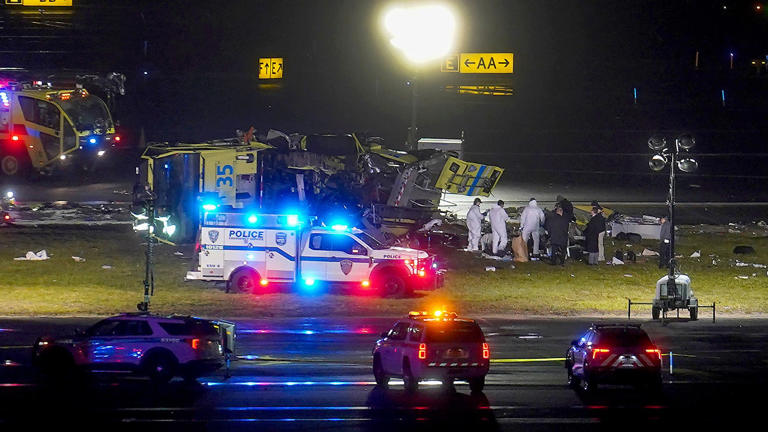
Newly released air traffic control recordings capture the tense moments surrounding a deadly collision Sunday night at New York’s LaGuardia Airport that killed two pilots and injured dozens of others.
In the recordings, controllers can be heard urgently trying to halt both an aircraft and an emergency vehicle shortly before the impact. One transmission includes repeated warnings directed at the vehicle on the runway.
“Stop, Truck 1. Stop,” a controller said. “Frontier 4195, stop there please. Stop, stop, stop.”
The situation quickly escalated as the controller continued shouting instructions over the radio. “Truck 1, stop, stop, stop,” the voice said. “Stop truck one. Stop!” Moments later, alert tones sounded while the controller began directing other vehicles and diverting an approaching aircraft away from the runway.
Separate audio from another pilot who witnessed the crash also surfaced. Speaking with the control tower afterward, the pilot described what had just happened.
“That wasn’t good to watch,” the Frontier pilot told the controller.
“Yeah, I know,” the controller replied. “I was here. I tried to reach out. … We were dealing with an emergency earlier. I messed up.”
The pilot responded by offering reassurance. “Nah man, you did the best you could.”
The fire truck involved in the crash had been dispatched to assist with a different situation involving a United Airlines flight. That aircraft’s pilot had reported an unusual odor in the cabin, prompting emergency crews to respond.
Authorities said the collision occurred when an Air Canada Express aircraft struck the emergency vehicle after landing on Runway 4 at LaGuardia around 11:45 p.m. Sunday. The plane, a CRJ-900 arriving from Montreal, suffered severe damage to its nose section.
The pilot and copilot of the aircraft were killed in the impact. In addition, 39 passengers and crew members were transported to nearby hospitals, some with serious injuries. Officials said Monday that most of those injured have since been released.
The Federal Aviation Administration confirmed the incident early Monday and announced that both the FAA and the National Transportation Safety Board are investigating, with the NTSB leading the inquiry.
Two employees of the Port Authority of New York and New Jersey who were riding in the fire truck were also hurt, though their injuries were not considered life-threatening, according to Port Authority Executive Director Kathryn Garcia.
Garcia said during a press briefing that both pilots were based in Canada. The emergency response vehicle was operated by the airport’s Aircraft Rescue and Firefighting unit, which is staffed by Port Authority police officers specially trained and certified as aircraft rescue firefighters by the FAA. Officers assigned to the unit must complete certification twice each year.
Garcia explained that emergency vehicles are required to obtain clearance from the control tower before entering or crossing any runway or taxiway. The audio recordings indicate the truck may initially have received permission to cross the runway before controllers urgently tried to reverse the instruction.
LaGuardia Airport was closed following the crash and remained shut down until at least 2 p.m. Monday while investigators examined the scene.
According to Air Canada, the flight was operated by Jazz Aviation and had departed from Montréal-Pierre Elliott Trudeau International Airport with 72 passengers and four crew members on board.
Images and video taken after the crash showed extensive damage to the aircraft’s cockpit area, with debris and cables hanging from the crushed front section. The emergency vehicle involved in the collision was seen overturned nearby.
Evacuation stairways were brought to the plane so passengers could exit through the emergency doors. The force of the crash left the aircraft’s nose severely crumpled and tilted upward as investigators began their work at the scene.