The Coming Islamization of American History
Posted For: Rotorblade
A growing debate is unfolding over how Islam and Muslim figures are represented in American history education, following recent discussions among progressive academics and politicians about expanding the historical narrative to include a broader range of cultural and religious influences.
The conversation gained traction after a Breitbart article titled “With Mamdani on Rise, Left Begins Rewriting American History to Elevate Muslims” suggested that some left-leaning educators and officials are attempting to reinterpret early American history through a more inclusive lens that emphasizes minority contributions.
Critics argue that this approach risks distorting the historical record and minimizing the role of the country’s founding ideals, which were deeply influenced by Judeo-Christian thought. Supporters counter that incorporating a wider range of perspectives provides a more complete understanding of America’s complex past.
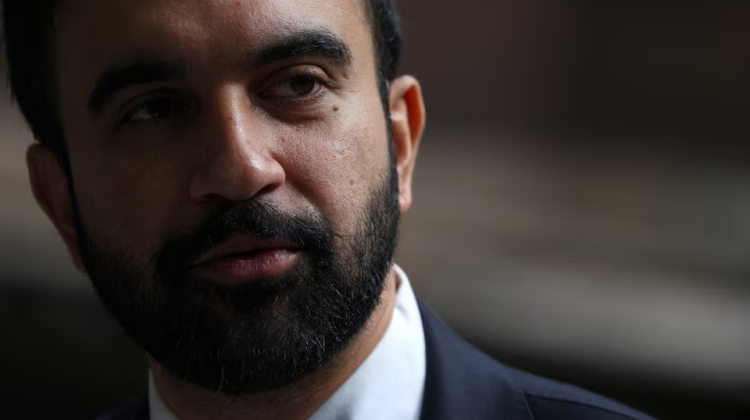
Among the figures mentioned in the debate is Zohran Mamdani, a New York state assemblyman who has identified as both Muslim and socialist. Mamdani’s political rise — and speculation about his potential bid for mayor — has drawn attention to his advocacy for progressive causes, including education reform and social equity. Opponents question whether his ideological background aligns with traditional American values, while his supporters see him as part of a new generation of leaders focused on inclusion and justice.
At the heart of the controversy is a philosophical disagreement about America’s founding principles. Many historians note that the Founding Fathers envisioned a limited government dependent on a virtuous and moral citizenry. John Adams famously wrote that “our Constitution was made only for a moral and religious people. It is wholly inadequate to the government of any other.”
The French observer Alexis de Tocqueville, who studied the young American republic in the 1830s, also emphasized the link between religion and civic virtue. He wrote that America’s moral foundation was key to its success, observing that “religion in America takes no direct part in the government of society, but it must be regarded as the first of their political institutions.”
Those opposed to revising early American history warn that weakening the nation’s traditional moral framework — especially its Judeo-Christian heritage — could undermine the civic virtue that de Tocqueville described as essential to republican self-government.
Some also cite de Tocqueville’s critical view of Islam, which he considered socially and politically rigid compared with Christianity. Others argue that such views reflect the biases of their time and should not define modern interpretations of Islam’s role in world history.
The larger question remains: how should America balance inclusivity and historical accuracy when teaching its past? As debates continue in classrooms and political circles, the struggle over history’s meaning — and who gets to define it — shows no sign of slowing down.
About Post Author


