A man identified by federal authorities as the suspect in Thursday’s deadly shooting at Old Dominion University had previously appeared in court years earlier, where he expressed regret for supporting ISIS and apologized to Americans and the U.S. military, according to court records.
Mohamed Bailor Jalloh made those remarks during a February 2017 sentencing hearing after he was convicted of attempting to provide material support to ISIS, which is classified as a foreign terrorist organization. At the hearing, he acknowledged his involvement and told the judge he had been struggling at the time and searching for direction in his life. He told the court that his actions spiraled beyond his control and asked for another opportunity to move forward.
Jalloh also spoke about his military background during the hearing. He served in the Virginia National Guard from 2009 until 2015 as a combat engineer and said that his time in uniform represented the proudest period of his life.
The court ultimately sentenced him to 11 years in federal prison, along with five years of supervised release. The judge, U.S. District Judge Liam O’Grady, noted that Jalloh had no prior criminal record and had served in the National Guard, but said the crime was particularly troubling given that background. The judge said the sentence needed to reflect both the positive aspects of Jalloh’s past and the seriousness of the offense, especially because he had taken concrete steps to support ISIS despite his military service.
According to the Associated Press, Jalloh, who lived in Sterling, Virginia, was released from federal custody earlier than expected in December 2024. Officials have not publicly explained why his sentence was shortened.
Federal investigators later identified the 36-year-old Jalloh as the gunman in the shooting at Old Dominion University’s campus in Norfolk. The attack left one person dead and two others wounded. The victim who died was Army Lieutenant Colonel Brandon A. Shah. The two injured individuals were also members of the U.S. Army, according to Army Secretary Dan Driscoll.
FBI Director Kash Patel said the bureau is treating the incident as an act of terrorism.
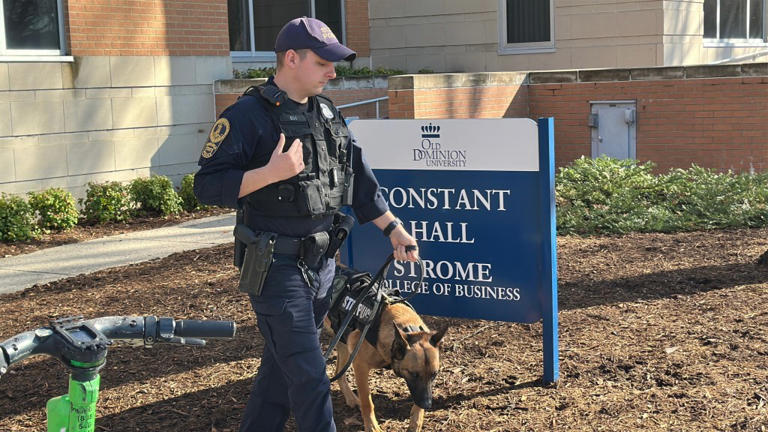
Police are present at Constant Hall, where yesterday’s shooting occurred on Friday, March 13, 2026 at Old Dominion University in Norfolk, Virginia.
Dominique Evans, the special agent in charge of the FBI’s Norfolk field office, said the attacker shouted “Allahu Akbar” during the assault. The situation was stopped when a group of ROTC students confronted and subdued him inside a classroom, ultimately ending the threat.
ROTC, or Reserve Officers’ Training Corps, is a college program that allows students to train for military officer roles while completing their university education.
Court documents from Jalloh’s earlier case described a lengthy FBI investigation that began years before his conviction. During that investigation, authorities said Jalloh expressed interest in carrying out a violent attack in the United States inspired by past acts of domestic terrorism. Prosecutors said he referenced the 2009 Fort Hood shooting, which killed 13 people, and indicated he wanted to conduct a similar attack.
An FBI affidavit stated that in early 2016 Jalloh attempted to contact people he believed were connected to ISIS, although investigators later determined that at least one of those individuals was a government informant. Prosecutors also said he tried to send money to the group and attempted to purchase a rifle from a gun store in Virginia. The firearm he obtained had secretly been modified so it could not function, and he was arrested soon afterward.
During his sentencing hearing in 2017, Jalloh repeatedly apologized and said he rejected the actions of ISIS. He told the court he felt disgusted whenever he saw reports of the group’s violence and atrocities. He said he did not want to be associated with the organization and expressed remorse to the court, the American public, and members of the U.S. military.
He also told the judge that he had been experiencing serious emotional struggles at the time of his offense and felt lost and without direction. Jalloh insisted that his actions did not reflect who he believed himself to be and that he did not intend to harm anyone.
When questioned about his attempt to buy an AR-15 rifle, he said the purchase came after conversations with people around him and claimed he did not have a plan to use the weapon.
Jalloh ended his statement by apologizing to his family for the pain and embarrassment his actions had caused. He told the court he had cooperated with investigators by sharing any information he could recall because he wanted to demonstrate that he no longer supported ISIS and wanted no connection to the group.
He closed his remarks by again expressing regret for his actions and asking the court for a second chance.