Iran’s Cluster Bomb Missiles Raise Questions Over Russia And China’s Role

Iran’s Cluster Missile Attacks Raise Questions About Assistance
Israeli military officials say Iran has launched ballistic missiles equipped with cluster munitions toward Israeli territory, marking what they describe as the first known use of such weapons in the current conflict.
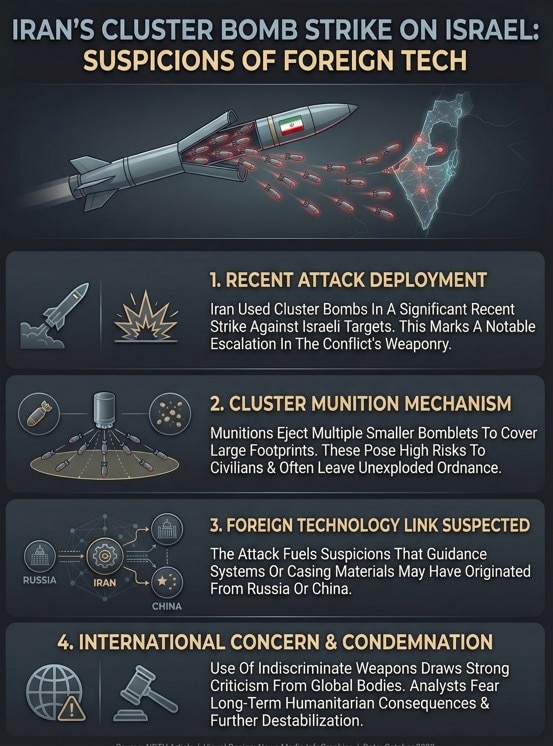
Cluster weapons are among the most controversial types of modern armaments. Unlike conventional bombs that detonate in a single blast, cluster munitions disperse multiple smaller explosives across a wide area. Israeli defense officials report that some Iranian cluster warheads can release up to 80 submunitions in mid-air, scattering explosive fragments over several kilometers.
Military analysts say the use of these weapons could significantly change the dynamics of the war. Instead of a single explosion at a specific target, cluster warheads distribute numerous smaller bomblets across a large area. This increases the risk to civilians and can leave behind unexploded ordnance that remains dangerous long after the initial strike.
The issue has also raised questions about how Iran developed this capability. In a country where scientists connected to advanced weapons programs have often been targets of assassinations, Israeli experts speculate that outside assistance may have contributed to the development of cluster-capable missiles. Some analysts have suggested the possibility of technological support or transfers from Russia or China.
Strike Near Tel Aviv
According to Israeli military officials, at least one Iranian ballistic missile carrying cluster munitions struck central Israel during a recent wave of attacks.
Israeli reports say the missile’s warhead separated at an altitude of roughly four miles (about seven kilometers), releasing around 20 submunitions that spread across an estimated five-mile (eight-kilometer) radius.
One of the bomblets hit a home in the town of Azor, south of Tel Aviv, causing structural damage. Authorities said no casualties occurred in that specific incident. However, the wider missile barrage reportedly injured at least 12 people.
Since February 28, Iranian ballistic missile strikes have killed at least 11 people in Israel and injured more than 1,000 others to varying degrees, according to reports cited by NBC News.
The Israeli military also issued public warnings about unexploded submunitions that could still be present in affected areas.
Brigadier General Effie Defrin, a spokesperson for the Israeli military, accused Iran of deliberately using weapons designed to increase civilian harm.
“The terror regime seeks to harm civilians and even used weapons with wide dispersal in order to maximise the scope of the damage,” he said.
A Changing Pattern in the Conflict
Iran has continued launching missile barrages toward Israel throughout the week, though the number of attacks has varied.
On March 3, Iran reportedly fired at least six missile barrages toward Israel, the same number launched the previous day. That is significantly lower than February 28, when Israeli officials recorded about 20 missile barrages in a single day.
Despite the reduced frequency, Israeli defense officials say cluster warheads introduce new operational challenges. Because they disperse multiple explosives over wide areas—often including urban zones—they increase the difficulty of interception and create additional hazards on the ground.
Officials believe Iran has fired at least five cluster-munition missiles toward Israel since Saturday, many targeting densely populated civilian regions.
How Cluster Warheads Work
Traditional ballistic missiles typically carry a single warhead weighing between 500 and 1,000 kilograms.
Cluster warheads operate differently. After the missile reaches a certain altitude, the warhead opens and releases multiple smaller bomblets. Each submunition usually carries an explosive charge of up to about seven kilograms, comparable in power to short-range rockets used by militant groups such as Hamas and Hezbollah.
While each individual explosion is smaller than a standard warhead, the total damage can be greater because the explosives are spread across a wide area.
Israeli officials say the missile used in the recent attack split at around seven kilometers above the ground, scattering submunitions across an area roughly eight kilometers wide.
Experts note that cluster weapons can become even more dangerous if intercepted mid-air. When a missile is destroyed before completing its trajectory, the bomblets may fall unpredictably, sometimes detonating on impact or remaining unexploded.
Those unexploded submunitions can pose long-term risks. Many fail to detonate immediately and can remain active for years, functioning like improvised landmines if disturbed.
Previous Use and Missile Systems
Israeli defense officials say Iran previously used cluster-capable missiles during a 12-day conflict between the two countries last June.
During that earlier confrontation, three cluster missiles were reportedly launched, striking seven Israeli cities.
Israeli analysts believe Iran has developed at least three missile systems capable of carrying cluster warheads:
-
Zolfaghar short-range ballistic missile
-
Qadr-series longer-range ballistic missiles
-
Khorramshahr heavy ballistic missile
The Khorramshahr system is considered the most powerful. Iran claims it has a range of roughly 2,000 kilometers and can carry as many as 80 submunitions.
Iran’s Cluster Weapons Capability
Iran rarely discusses its cluster munitions program publicly. However, evidence suggests the country produces such weapons for use with both ballistic missiles and rockets.
Iranian state media has previously reported that the domestically produced Qadr-S ballistic missile carries a cluster munition warhead and can reach targets up to 2,000 kilometers away.
Western analysts have also suggested that the Zolfaghar missile could deliver cluster payloads.
In 2015, Iranian authorities displayed a variant of the Fateh missile equipped with 30 submunitions, each weighing about 20 pounds.
Other systems may also be adaptable. Analysts cited by The New York Times suggested that a Qiam-series missile—based on the Soviet-era Scud design—or a larger Khorramshahr missile may have delivered cluster munitions in a June 2025 attack on Israel.
Iran also manufactures several types of unguided rockets, including 122mm, 240mm, and 333mm systems, though it is unclear whether those rockets can carry submunition payloads.
Imported Systems and Global Debate
Open-source intelligence compiled by Jane’s Information Group lists Iran as possessing several foreign cluster weapons systems, including KMGU dispensers designed to release submunitions, as well as PROSAB-250 and BL755 cluster bombs originally produced in the United Kingdom.
Iran has never publicly revealed the size or composition of its cluster-munition stockpile.
Cluster weapons remain highly controversial internationally. In 2008, more than 100 countries signed the Convention on Cluster Munitions, a treaty banning the use, production, transfer, and stockpiling of such weapons.
A total of 111 countries and 12 additional entities have joined the agreement. Neither Israel nor Iran signed the treaty, and the United States also declined to join.
The issue drew renewed attention in 2023 when the United States supplied cluster munitions to Ukraine for use against Russian forces. Ukraine has also accused Russian troops of deploying cluster weapons during the war.
About Post Author


