Neil Sedaka in 1977. (Michael Putland / Getty Images)
Neil Sedaka, the irrepressible songsmith who parlayed his compositional talents into pop stardom during the height of the Brill Building era in the 1960s and later mounted a successful easy-listening comeback in the 1970s, has died at 86. No cause of death was immediately available.
“Our family is devastated by the sudden passing of our beloved husband, father and grandfather, Neil Sedaka,” his family said in a statement to The Times. “A true rock and roll legend, an inspiration to millions, but most importantly, at least to those of us who were lucky enough to know him, an incredible human being who will be deeply missed.”
A gifted melodist who never hid his sentimental streak, Sedaka rose just as rock ’n’ roll’s first explosion began to cool. As both songwriter and performer, he treated the genre as a vibrant new marketplace, crafting buoyant tunes aimed at teenagers who danced to “Stupid Cupid” and swooned to “Where the Boys Are,” two hits he wrote with lyricist Howard Greenfield for Connie Francis.
Sedaka soon became a star in his own right with effervescent hits such as “Calendar Girl,” “Happy Birthday, Sweet Sixteen” and 1962’s chart-topping “Breaking Up Is Hard to Do,” which became his signature song.
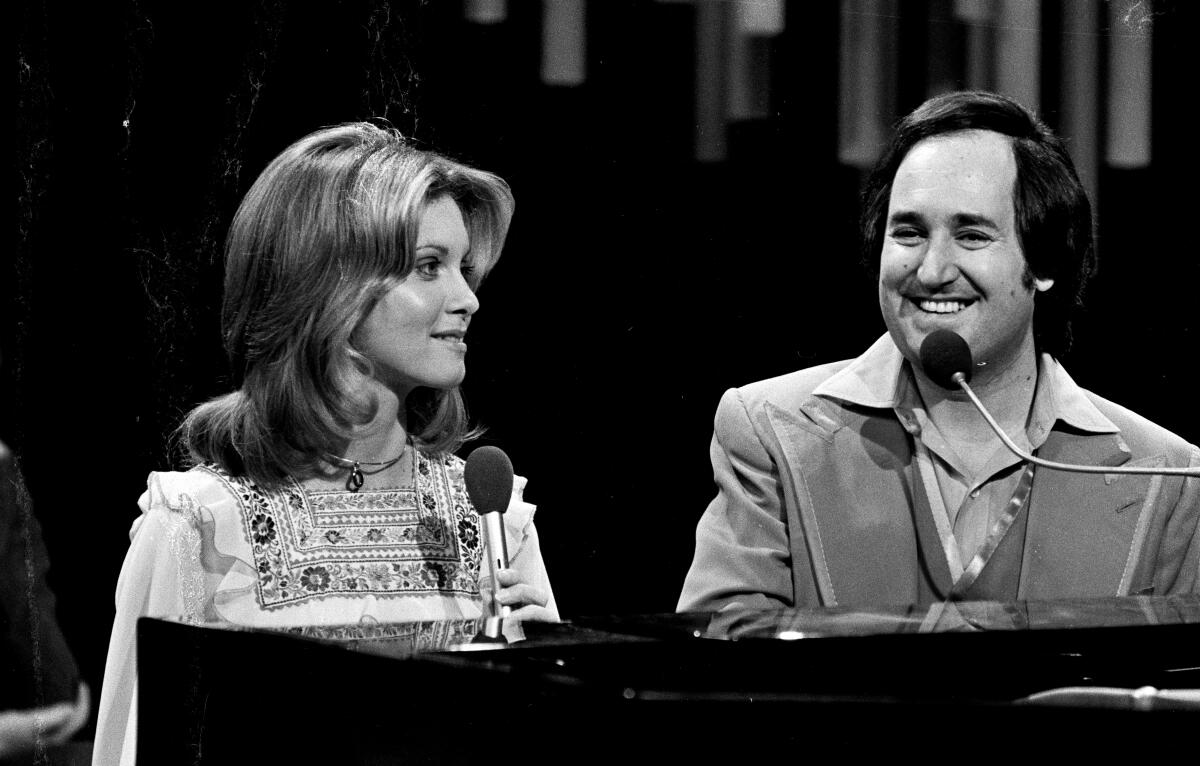
Olivia Newton-John and Neil Sedaka performing in a BBC television studio in 1971. (Warwick Bedford / Radio Times via Getty Images)
By the time The Beatles arrived in the United States, Sedaka’s polished pop style was falling out of fashion. The British Invasion proved difficult to weather; by the late 1960s, without a record label, he left the U.S. for England. Unlike fellow Brill Building alum Carole King — the inspiration behind his early hit “Oh! Carol” — Sedaka did not reinvent himself as a confessional singer-songwriter. Instead, he relied on sharp commercial instincts and showbiz determination.
In the early 1970s, he teamed with the musicians who would become 10cc, recording albums that placed him squarely in the soft-rock mainstream. His fortunes shifted dramatically when Elton John signed him to his Rocket label. Sedaka scored two No. 1 hits in 1975 with “Laughter in the Rain” and “Bad Blood,” while Captain & Tennille took his composition “Love Will Keep Us Together” to the top of the charts that same year.
Though his renewed chart dominance was brief — by 1980 he was no longer a Top 40 fixture — the comeback cemented his status as a durable entertainer. Over the decades, Sedaka maintained a steady presence onstage and occasionally returned to the mainstream spotlight, including an appearance on American Idol in the early 2000s.
Born March 13, 1939, in Brooklyn, New York, Sedaka was raised in Brighton Beach in a family of Turkish and Ashkenazi Jewish heritage. A musically gifted child, he earned a piano scholarship at age 8 to the children’s division of Juilliard School, where he studied classical piano while nurturing a love for pop music.
At 13, he met Greenfield at a Catskills resort, launching a songwriting partnership that would define his early career. Sedaka also briefly sang with the Linc-Tones, later known as The Tokens, before focusing primarily on writing.
Neil Sedaka in 1960. (Bettmann Archive/Getty Images)
After signing with RCA Records in the late 1950s, Sedaka broke through with “The Diary” and soon followed with “Oh! Carol,” a Top 10 hit. Throughout the early ’60s, he delivered a string of upbeat, teen-focused hits including “Stairway to Heaven,” “Next Door to an Angel” and others that paired ornate arrangements with his bright, youthful delivery.
As tastes shifted in the mid-1960s, his hitmaking slowed. He continued writing for artists including The Monkees and the The 5th Dimension, but found greater success overseas. His 1972 album “Solitaire,” recorded with future members of 10cc, marked the beginning of his resurgence.
Sedaka’s later career included the 1980 duet “Should’ve Never Let You Go” with his daughter Dara, induction into the Songwriters Hall of Fame in 1983, and a series of stage productions built around his catalog. He also explored classical music and recorded themed albums celebrating his heritage and family audiences.
In 2007, Lincoln Center honored his 50 years in show business with a gala concert. He continued performing into the 21st century, even taking his concerts online during the COVID-19 pandemic in 2020.
Sedaka is survived by his wife, Leba; daughter Dara; son Marc; and three grandchildren.