


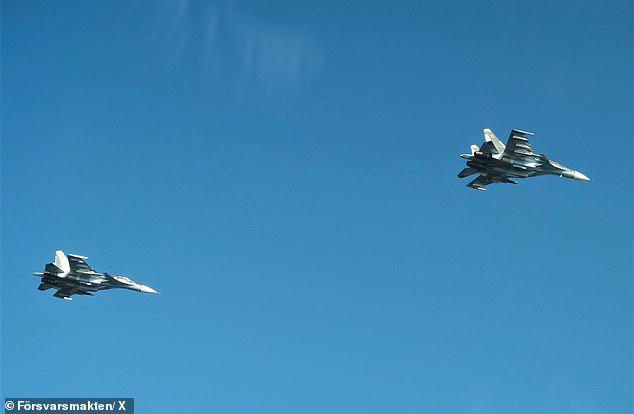
NATO fighter jets intercepted two armed Russian Su-30 warplanes over the Baltic Sea, as President Vladimir Putin continues to escalate military posturing against the West.
The Swedish Air Force confirmed that its JAS 39 Gripen fighters intercepted the Russian aircraft, which were reportedly equipped with Kh-31 missiles — high-speed, anti-radiation weapons designed to target ships and air defense systems. The operation was carried out with support from Denmark.
Also identified during the interception was an Il-20M signals intelligence aircraft, which specializes in electronic and communications surveillance. It was swiftly escorted away from the area.
“The Swedish Air Force is always on alert,” the nation’s Armed Forces posted on X (formerly Twitter) following the successful mission, which took place in international airspace over the southern Baltic Sea. The Russian aircraft had been flying without flight plans and with their transponders switched off — a common tactic to avoid detection.
Both intercepted Su-30 jets, one SM and the other SM2 variant, are believed to be part of Russia’s Baltic Fleet and were carrying Kh-31 missiles capable of reaching speeds up to Mach 3.
The latest confrontation follows a series of incidents that have triggered alarm across Europe. On September 9, up to 23 Russian drones reportedly breached Polish airspace. Days later, Romania accused Moscow of a similar violation, and Latvia reported a drone crash in its eastern territory.
Most recently, on Monday, a civilian drone flew over Poland’s presidential palace and key government buildings. Authorities described the incident as another deliberate provocation.
Meanwhile, Russia has launched joint military exercises with Belarus, known as the Zapad 2025 drills, raising fresh concerns among NATO allies. These war games — often seen as rehearsals for real conflict — featured fighter jets, drones, helicopters, and ground troops conducting live-fire exercises near the Polish border.
In response, Poland deployed 40,000 troops to its eastern frontier and temporarily closed its border with Belarus. Polish Prime Minister Donald Tusk called the drills “very aggressive” and warned that Europe is now “closer to open conflict than at any time since World War Two.”
President Alexander Lukashenko of Belarus — a longtime ally of Putin — has continued to support Moscow’s military operations, allowing Russian troops and tactical nuclear weapons to be stationed within his country.
To reinforce the eastern flank, NATO has launched Operation Eastern Sentry, deploying military assets including two Danish F-16s and a frigate, three French Rafale jets, and four German Eurofighter Typhoons.
Military experts warn the situation is becoming increasingly volatile. Hamish de Bretton-Gordon, a former British Army colonel, said NATO must respond decisively.
“NATO has suddenly — or finally — woken up,” he said. “For too long we enjoyed the peace dividend and sent the message that we weren’t serious. That needs to change.”
There are growing calls for NATO to step up support for Ukraine, especially in defending its airspace. Polish and Ukrainian leaders have suggested NATO forces should begin shooting down Russian drones and missiles over Ukraine — a step that could risk direct confrontation with Moscow.
“I’ve been calling for a no-fly zone against civilian targets in Ukraine,” de Bretton-Gordon added. “We must show Putin we’re serious. We shouldn’t be intimidated by threats from the Kremlin.”
Ukrainian President Volodymyr Zelensky reported that in just the past two weeks, Russia has launched over 3,500 drones, 2,500 glide bombs, and nearly 200 missiles at Ukrainian targets — underscoring the scale of the ongoing assault.