


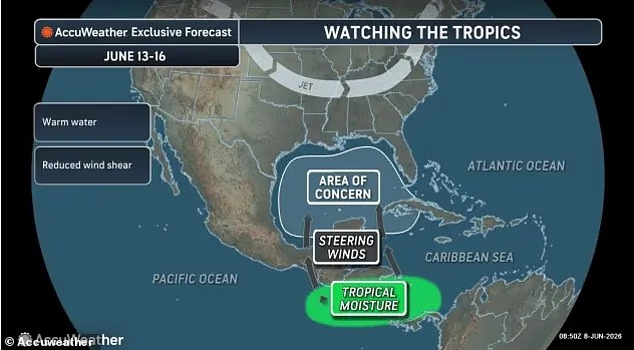
Hurricane trackers are keeping a watchful eye on the Gulf of America for possible tropical development in the coming days.
While forecasters do not expect a major tropical cyclone, they are monitoring a potential low-pressure system that could bring heavy rain and flooding to parts of the Southeast by at least June 13.
Forecast models suggest the disturbance could form in the Gulf or western Caribbean around the middle of the month before tracking northward toward the US.
Warm ocean waters and a gradual decrease in disruptive wind shear could create a more favorable environment for development.
Some forecast models have indicated better-than-even odds that the system could organize into at least a tropical depression, an organized cluster of thunderstorms with sustained winds of up to 38mph.
The potential threat is linked to a sprawling weather pattern known as the Central American Gyre, which commonly develops over Central America and the Caribbean during June.
While the phenomenon does not always produce a named storm, it can act as a breeding ground for early-season tropical systems and draw large amounts of tropical moisture northward.
That moisture, rather than strong winds, is currently the main concern for forecasters.
AccuWeather Senior Meteorologist Alex Sosnowski said in a statement: ‘Should the storm form, along with the risk of flash flooding, downpours could be directed into some drought-stricken areas of the eastern US near and shortly after the middle of the month.’
Forecasters stressed that considerable uncertainty remains over whether a tropical system will form at all.
Even if development occurs, strong wind shear could limit its strength and keep it relatively weak and disorganized.
However, such systems can still produce torrential rainfall and localized flooding well away from their center.
The potential Gulf threat comes even as the Atlantic hurricane basin remains relatively quiet. According to the National Hurricane Center, no organized tropical systems are currently active and no immediate tropical development is expected across the Atlantic.
Several tropical waves continue to move westward across the Atlantic and Caribbean, including disturbances near West Africa and deeper in the tropical Atlantic that are producing clusters of thunderstorms.
Another tropical wave in the central Caribbean is generating showers and storms near Jamaica and surrounding waters.
In the Gulf of America, high pressure is maintaining generally calm conditions with moderate east-to-southeast winds.


Forecast models suggest the disturbance could form in the Gulf or western Caribbean around the middle of the month before tracking northward toward the US
However, forecasters expect storm activity and rougher seas to increase later this week near the Yucatán Peninsula and the southwestern Gulf, where conditions could become more favorable for development.
The Caribbean remains active, with moderate to fresh trade winds and pockets of heavy rain associated with the tropical wave near Jamaica.
Stronger winds are also expected to develop across portions of the basin later this week.
Meanwhile, a surface trough near the Bahamas is producing scattered showers over parts of the western Atlantic, while strong high pressure continues to dominate much of the ocean basin.
There are currently no direct tropical threats to Florida or the US coastline.
However, meteorologists expect tropical moisture to steadily increase over the coming days, bringing higher humidity, greater chances for downpours and more widespread afternoon thunderstorms.
Forecasters say Florida could return to a wetter summer weather pattern by late week, even if no organized tropical system develops.
–